
Bitcoin mining often feels like a lottery for everyday hobbyists. Devices like the Bitaxe Gamma 601—a tiny, open-source ASIC miner packing just 1.2 TH/s at around 15–17 watts—aren’t competing with industrial farms. They’re solo “lottery miners,” plugging away in bedrooms or garages with astronomical odds of claiming a full block reward.
Under normal conditions, a Bitaxe might expect to solve a block once every 14,000 years. Yet certain events flip the script. Bitcoin’s built-in difficulty adjustment can suddenly make mining dramatically easier, slashing those odds and giving low-hashrate setups their best window to win big. It is in these moments precisely that solo lottery miners can “turn cold into gold”.
To understand why, start with the basics of how Bitcoin secures itself. Every block requires miners to find a nonce that produces a SHA-256 hash below a specific target value. The network adjusts this target—known as the difficulty—every 2,016 blocks (roughly two weeks) to maintain an average block time of 10 minutes. If total network hashrate (computational power) rises, blocks come too fast and difficulty increases. If hashrate falls, blocks slow down and difficulty drops at the next adjustment, making it easier for every remaining miner to find valid hashes.
The formula for a miner’s expected time to find a block is straightforward:
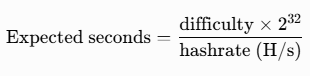
Divide by 31,557,600 (seconds in a year) and you get the lottery timeline. For a Bitaxe at 1.2 TH/s (1.2 × 10¹² H/s) when difficulty sits around 125–144 trillion (typical early-2026 levels), that works out to roughly 14,275 years. Not exactly encouraging—but here’s the magic: when difficulty falls, that number shrinks proportionally.
Two real-world triggers reliably cause hashrate to plummet and trigger these downward adjustments: sharp price crashes and widespread power disruptions from snow storms or winter weather.
Sharp Price Crashes
Bitcoin’s revenue per unit of hash (hashprice) is directly tied to the coin’s market value. When prices tumble, many large-scale operations become unprofitable overnight. Electricity bills don’t drop, but daily BTC earnings do. Miners respond by powering down rigs en masse.
In early 2026, Bitcoin plunged more than 45% from its October 2025 all-time high above $126,000 to around $60,000. The result? Network hashrate cratered roughly 20% in a month, falling from peaks near 1.1 ZH/s (1,100 EH/s) to as low as 863 EH/s. This triggered the largest single negative difficulty adjustment since China’s 2021 mining ban: an 11.16% drop on February 7, 2026, bringing difficulty down to about 125.86 trillion.
For a Bitaxe owner, that 11% reduction cuts expected block time by the same factor—down to roughly 12,700 years. Still a long shot, but 1.12× better odds overnight. And because small home miners typically run on cheap or fixed residential electricity, they often keep hashing when industrial farms shut off. Their relative share of the remaining hashrate effectively grows.
Snow Storms and Power Outages
The second trigger—snow storms and power outages—produces the same effect, sometimes even faster. Severe winter weather strains electrical grids, forcing utilities to issue curtailment orders or causing outright blackouts in mining-heavy regions. In late January 2026, Winter Storm Fern swept across the United States, hitting Texas, the Midwest, and other hubs hard. Major pools like Foundry USA saw hashrate collapse by up to 60% in affected areas as operators powered down to conserve grid capacity for homes and hospitals. Overall network hashrate dropped another 10–12% in days, compounding the price-driven decline already underway.
These outages don’t just slow the network temporarily; they delay block production enough to force the next difficulty epoch lower. The adjustment doesn’t happen instantly—it waits for 2,016 blocks to be found—but once it does, the entire network (including your Bitaxe) operates under easier rules until hashrate recovers and difficulty climbs again.
What makes this especially exciting for lottery miners is the timing and asymmetry. Big operations dominate the hashrate (often 70%+ from public companies and pools), so when they curtail, the drop is sharp. Small devices like the Bitaxe—silent, low-power, and runnable anywhere—stay online. You’re not causing the difficulty drop, but you’re perfectly positioned to benefit from it. During the pre-adjustment period while blocks arrive slowly, the network still pays the same 3.125 BTC subsidy (plus fees) per block. Once difficulty resets lower, every hash your Bitaxe submits has a higher chance of success.
Real numbers from 2026 illustrate the scale. Before the February adjustment, hashrate hovered around 860–900 EH/s. After the 11% difficulty cut, the network effectively needed 11% fewer hashes per block. For any fixed hashrate miner who stayed running, block-discovery speed improved by that exact margin. Hobbyists monitoring tools like mempool.space or difficulty estimators could literally watch the window open.
Of course, these easier-mining periods don’t last forever. As prices stabilize or storms pass, surviving miners (and new ones) ramp back up. Hashrate rebounds, blocks speed up, and difficulty climbs—sometimes aggressively, as seen in the 14.73% upward adjustment just two weeks after the big drop. The sweet spot for Bitaxe users is right after a negative adjustment, especially when multiple factors (price + weather) align.
This dynamic also highlights Bitcoin’s elegant self-regulation. Difficulty isn’t manipulated by any central authority; it’s pure code responding to real-world incentives and events. Price crashes weed out inefficient operators. Storms test geographic centralization. In both cases, the protocol lowers the barrier to entry precisely when capacity exits, keeping block times stable over the long run while temporarily rewarding those who keep the lights on.
For the Bitaxe community—tinkerers who love the open-source firmware, OLED displays, and the pure thrill of solo mining—this creates genuine moments of hope. Sure, hitting a block remains unlikely even with easier difficulty. But the relative improvement turns a statistical impossibility into a slightly less impossible dream. Some enthusiasts run multiple units, join temporary solo pools, or simply enjoy the heating byproduct in winter while watching difficulty charts.
For the “tinkerer’s who love pushing their lottery mining devices to the limit, cold weather gives yet another gift: hardware efficiency. Lower ambient temperatures allow for better cooling, preventing overheating, which enables solo miners like the Bitaxe Ultra, Gamma, or even NerdQaxe to run at much higher speeds without overheating, especially if you keep them in the garage.
Next time Bitcoin’s price takes a dive or forecasters warn of a massive winter storm, keep an eye on the hashrate and upcoming adjustment. Fire up that Bitaxe (or your next-gen model). The network might just hand lottery miners their best odds in years—right when the big players blink.
In the end, Bitcoin’s resilience isn’t only in its security; it’s in these built-in opportunities for the “little guy”. Price crashes and snow storms don’t break the system—they reset it, giving compact, efficient miners like the Bitaxe Gamma 601 a brief but real chance to strike gold.