
Posted on: March 7, 2026 By Bitaxemining Community Admin | Last Updated: April 20, 2026
From the very beginning, mining of Bitcoin has always been a story of extremities. On the one hand, there were huge industrial farms that produced exahashes of computing power. However, on the other hand, there were also enthusiasts with small miners trying to achieve their dream about the “lottery mining” which is also known under such an exotic name due to really low probabilities of success for a small miner named “David” that would be able to defeat a multi-million dollar mining machine, the “Goliath”.
Still, even by 2026, the activity of low hash rate mining will remain popular due to the following factors: interest in decentralization of Bitcoin; education and demonstration of mining principles through using USB-based lottery miners (Nerdminer, NMMiner, etc.), and a hobby for experimenting. Of course, the reward for finding a block is also high enough ($250 thousand, depending on the BTC exchange rate). Therefore, winning in and learning about blockchain technologies can also be equally fulfilling to both hobbyists and teachers.
After considering the recent past in which Bitcoin 2024 halving took place and where the hashrate of the Bitcoin network exceeded 1 ZH/s towards the end of 2025, it is clear that there are changes ahead for hobbyists. The future is likely to see the emergence of devices that consume less electricity but can achieve more. In the coming year 2026, let us look at some of these trends.
New and Upcoming Lottery Mining Devices for 2026
Some new and upcoming lottery mining devices for 2026 are as follows:
Bitaxe Gamma Turbo
Bitaxe Gamma Turbo, or Bitaxe GT, is also known as the late-2025 version. The Bitaxe Gamma Turbo contains two Bitmain BM1370 ASIC chips and is similar to the Antminer S21 Pro in terms of hashing speed and efficiency, reaching 2.2-2.5 TH/s while using only 40 watts of energy.
Bitaxe Hex (early-2025)
This product is built on a multi-chip system with 6x BM1366 chips and reaches a hashing speed of 3.5-4.2 TH/s while only using up to 90 watts of energy.
NerdQaxe++ (mid-2025)
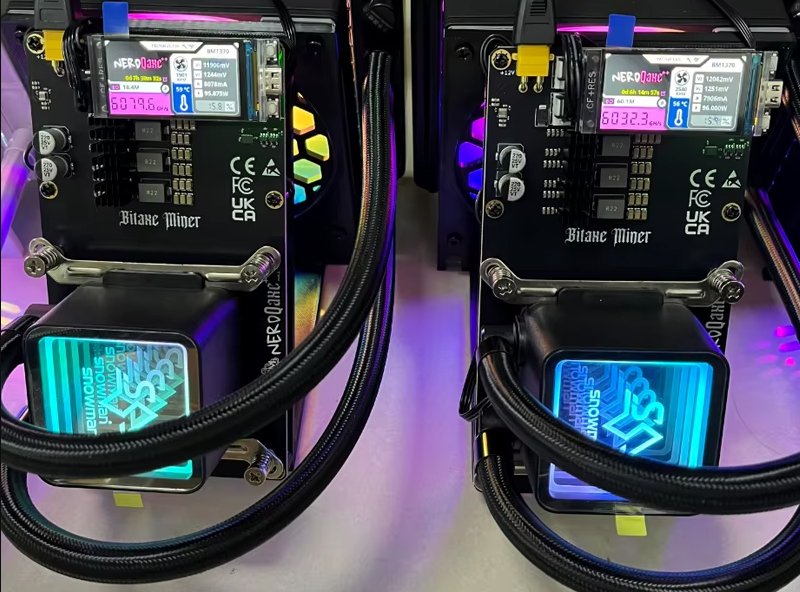
Hybrid device with a multi-chip system similar to a regular ASIC miner, while featuring a NerdMiner-like design and monitor screen. The Bitaxe Nerd++ includes four BM1370 chips, the high-performance chips included in the Bitmain Antminer S21 Pro. The NerdQaxe++ can hash anywhere from 4.8 to 6.0 TH/s while using just 60-100 watts of energy. In the basic form, NerdQaxes include low-profile air coolers such as the Thermalright AXP90 X36, but towards the end of 2025, “Hydro” versions became available, which were actually liquid-cooled.
 Mars Lander V3 (2026)
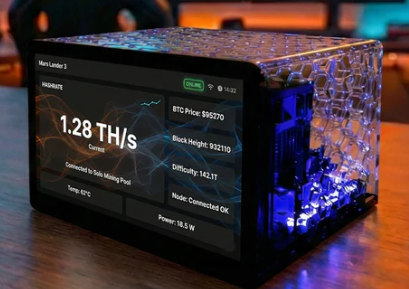
The Mars Lander 3 (illustrated in the figure to the left) is an advanced model that includes everything necessary for Bitcoin mining in one single package. This product is not only a solo miner but also a full Bitcoin node. Contrary to earlier devices that solely focused on mining operations, Mars Lander 3 gives the ability to verify the whole chain and mine into your personal wallet without involving any other third parties, such as pools or middlemen. The specifications include a hashing power of 1.2TH/s, in addition to a 2TB SSD, which will hold the entire blockchain and 16GB of RAM. This Mars Lander 3 will be launched in spring 2026 at a price point of $1,999.99.
Avalon Miner A16-282T (2026)
This is the latest flagship air-cooled miner. It has an upgraded 14cm high static pressure fan, which ensures 25% more airflow compared to other generations. Currently on sale for a pre-order price of about $4,480.
Avalon Miner A16XP-300T (2026)
The next generation, performing at 300 TH/s hashing power. It’s made for optimal efficiency in professional mining setups, and can be pre-ordered for around $5,950.
FutureBit Apollo III (2026)
The FutureBit Apollo III is engineered to be an all-in-one “sovereign computing” system that incorporates both a high-end miner and a complete Bitcoin node into one system. It can generate up to 18 TH/s in Turbo mode, which almost doubles the efficiency of the Apollo II. It features a desktop-grade control system that has 8 ARM cores, 8 GB RAM, and a 2 TB SSD that is used for hosting a complete, unpruned Bitcoin node. It uses 100 W to 350 W+ power consumption, depending on the chosen mode (Eco, Balanced, and Turbo).
Speculation: Will New Tech Make Winning Blocks More Accessible?
Several recent trends may enhance the individual mining experience:
Use of Stratum V2 protocols: These new technologies may increase decentralization by cutting down the dependency on large pools and increasing the efficiency of solo miners.
Use of AI to optimize energy consumption: AI can help in managing hashrates, voltages, and cooling of the machine, ensuring that there is no wastage of energy.
Usage of renewable energy sources: A solar panel and micro hydroelectric plant could be integrated into mining equipment.
Upgrading firmware: The community-driven development and tweaking of firmware could help in pushing machines to their limits safely, thus increasing the chances of block discovery.
Understanding Your Odds
Even with a 1 TH/s rig such as a Bitaxe Gamma, solo mining is largely a numbers game. Current network difficulty puts daily block chances in the 1-in-millions range. Yet, stacking multiple low-power devices, maintaining high uptime, and leveraging firmware optimizations increases effective odds over months or years. Hobbyists often enjoy running odds calculators, like the one at Axeminer.com, to see how combinations of rigs affect potential outcomes.
Though there is little hope for any block reward, the hobby of mining is both educational and enjoyable. The allure of what could happen, rather than what will happen, keeps the hobbyists interested.
Key Trends Shaping 2026
Several emerging trends are redefining the low-hashrate mining landscape.
1. Post-Halving Efficiency Focus
The next halving is projected to happen in 2028, when rewards will be reduced by half once again, incentivizing miners to seek out machines with better J/TH ratios. Machines that require less than 20 to 30W of energy have become more attractive among home-based miners looking to avoid excessive utility costs.
Not only does efficiency reduce costs, but it also increases the ability of hobbyists to operate several machines at once without risking their safety.
2. Open-Source and Decentralization Push
Projects driven by the community, such as Bitaxe, have ushered in a new wave of “pleb mining,” which allows for thousands of small devices that offer significant hashrates without necessarily using mining pools. This concept represents the spirit of decentralization envisioned by Bitcoin in the first place.
The use of open-source hardware encourages enthusiasts to tinker with firmware, observe the hardware’s performance, and make adjustments to it.
3. Hybrid and Upgraded Models
2026 will see new iterations of proven ASIC chips, often derived from the Antminer S21 and S23 series, packaged into compact, quiet rigs delivering 1–5 TH/s. These devices are designed with home usability in mind: low noise, low power consumption, and integrated monitoring displays.
Hybrid models like the NerdQaxe++ combine display features with high efficiency, allowing solo miners to track hashrate and temperature on a small LCD while maintaining stable performance.
4. Rising Network Difficulty
Network difficulty continues to increase alongside the overall hashrate, keeping the odds of winning blocks slim. Yet, recent low-hashrate block wins prove that “lottery mining” is still viable. Hobbyists who run multiple devices, optimize uptime, and participate in small, decentralized pools improve their chances, even if marginally.
5. Integration with Home Use
Rigs of the future are going to be multi-purpose rigs. Some of the rigs act as a desk decoration, a heater, or an air fan while working in the background. Rigs that use WiFi technology and have OLED and LCD screens are easy to monitor through mobile phones or computers.
Community and Collaboration
By engaging in the Open Source Miners United Discord group, or even our community forum at Axeminer.com, hobbyists gain access to firmware upgrades, efficiency tips, and the early ability to test new hardware through a collaborative effort where solo miners can discuss wins, losses, and experimental setups, thus creating a wealth of knowledge for themselves and their peers.
The educational component of using mining rigs provides another benefit, as many hobbyists use their mining machines to teach blockchain technology, energy conservation, and the basics of computer hardware engineering to students and loved ones.
Conclusion
It seems as though the future for the hobbyist miner is quite bright. The concept of utilizing low hash-rate mining rigs will continue to provide enthusiasts with an interesting mix of decentralized mining, education, and even luck. The development of new technology, open-source software, and collaboration within the community will allow for increased efficiency and excitement associated with the hobby. Although the chances of mining an entire block will be unlikely, learning experiences will still be gained by hobbyists and their contributions to the decentralized system of Bitcoin.
In the coming years, such as in 2026, look for a significant amount of development in devices that will appeal to hobbyists, especially those that are focused on efficient mining.